A countertop can look perfect in a showroom and still be the wrong choice once it meets a busy kitchen, a sunny patio door, or the layout of an older home. That is why custom countertops Lower Mainland homeowners choose should begin with more than a slab selection. The best results come from matching the material, edge profile, measurements, and installation details to the way the space will actually be used.
For a kitchen renovation, a bathroom update, or a commercial project, custom fabrication turns a surface into a finished architectural feature. It accounts for wall conditions, appliance openings, sink placement, overhang support, backsplash details, and the small visual decisions that make a room feel intentional.
What Makes a Countertop Truly Custom?
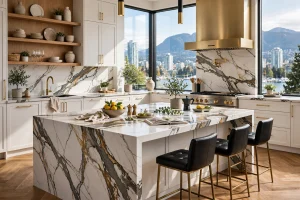
Custom does not simply mean choosing a premium stone. It means the finished surface is made for your room rather than cut to a standard size. Every home has its own conditions: walls may not be perfectly square, islands may need a specific seating overhang, and a large statement slab may need careful vein placement to look balanced.
A complete custom process starts with a consultation and an understanding of how you use the space. A family kitchen with daily cooking needs different priorities than a secondary bar area or a hospitality counter. During this stage, it helps to discuss practical details early, including the desired sink style, cooktop specifications, backsplash height, outlet locations, and whether the countertop will extend into a waterfall panel or full-height wall feature.
Once the design direction is clear, professional digital templating captures the actual dimensions of the finished cabinetry and walls. This is more precise than relying on rough measurements from a plan. The template is then translated into CAD-guided fabrication, allowing cutouts, seams, edges, and slab layout to be reviewed before the material is cut.
Choosing Materials for Lower Mainland Conditions
The right stone depends on the look you want, the maintenance you are comfortable with, and where the surface will be installed. There is no single best countertop material for every project. A material that performs beautifully in a low-traffic powder room may not be the most practical choice for a hard-working family kitchen.
Quartz for Consistent Color and Everyday Ease
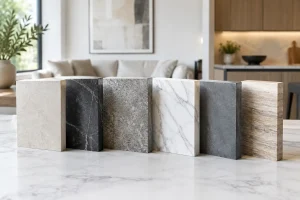
Quartz remains a popular choice for kitchens and bathrooms because it offers consistent patterning, strong stain resistance, and straightforward daily care. It is available in looks ranging from quiet whites and soft concrete tones to bold veining inspired by natural marble. Brands such as Vicostone, Silestone, and Cambria offer a wide range of colors and designs for both contemporary and classic interiors.
Quartz is well suited to many indoor applications, but it is not the right material for every situation. Direct heat can damage the resin content, so hot cookware should not be placed directly on the surface. Prolonged outdoor sun exposure is also a consideration, particularly for areas that receive strong UV light.
Granite and Quartzite for Natural Character
Granite and quartzite bring natural variation that cannot be duplicated from slab to slab. Their movement, mineral detail, and depth can make an island or feature wall feel one of a kind. Granite is known for its durability and can be an excellent fit for kitchens, bars, and certain outdoor applications when properly selected and sealed.
Quartzite is often chosen by homeowners who love the visual movement of marble but want a harder natural stone. However, each slab should be assessed on its own characteristics. Natural stone may require periodic sealing, and its patterns can vary significantly from a sample. Viewing the full slab is especially valuable when the material has dramatic veining or color shifts.
Marble for a Distinctive, Lived-In Finish
Marble has a timeless quality that works especially well in bathrooms, baking areas, fireplaces, and statement surfaces. It can also be used in kitchens, but it asks for realistic expectations. Marble can etch when exposed to acidic foods and drinks, and it develops a natural patina over time.
For some homeowners, that evolving character is exactly the appeal. For others, a marble-look quartz or sintered stone may provide a better balance of appearance and low-maintenance performance.
Sintered Stone for Heat and Outdoor Performance
Sintered stone, including Dekton, is engineered for demanding applications. Its resistance to heat, scratching, UV exposure, and staining makes it a strong option for outdoor kitchens, fireplace surrounds, and high-use surfaces. It can also create a clean, continuous look when the same material is carried from a counter to a backsplash or wall cladding.
Because large-format sintered slabs require specialized handling and fabrication, experience matters. Proper support, cutout preparation, and installation planning are essential to protecting the material and achieving clean lines.
Details That Change the Finished Look
The stone is only part of the decision. Edge profiles, thickness, seams, and backsplash treatment have a major effect on how custom countertops feel in the room.
A simple eased edge is versatile and works with nearly any cabinet style. A mitered edge can create the appearance of a thicker, more substantial slab, particularly on a large island. More decorative profiles may suit traditional cabinetry, while a crisp square edge often complements modern design. The right choice should reflect both the room’s style and how the edge will be used day to day.
Seam placement deserves the same attention. Some projects require seams due to slab size, room access, or the dimensions of an island. A thoughtful fabrication plan places them where they are least visible and aligns the material pattern as closely as possible. With heavily veined stone, the fabricator may recommend a layout that prioritizes vein flow over a particular seam location. That is a worthwhile discussion before fabrication begins.
Backsplashes also offer a chance to make the design more cohesive. A standard-height backsplash can be practical and cost-conscious, while a full-height stone backsplash creates a more refined, continuous finish. Behind a range, a full slab can reduce grout lines and turn a functional area into a focal point.
Why the Fabrication Process Matters
A premium slab cannot compensate for inaccurate measurements or rushed installation. The quality of the finished countertop depends on the process from the first consultation through the final fit.
At VE Stone Ltd., projects are managed from material selection and initial sketches through digital templating, CAD-guided fabrication, and professional installation. This end-to-end approach helps keep design decisions connected to real site conditions. It also gives homeowners a clear point of contact as cabinetry, plumbing, appliances, and stone installation need to come together in the correct sequence.
Before templating, cabinets should be installed, level, and securely fastened. Sink and cooktop models should be confirmed, and any specialty requirements, such as an undermount sink, integrated drain grooves, or support for a large cantilever, should be identified. Making changes after templating can affect timing and may require a new template, so this is the stage to confirm the details.
During installation, skilled crews check fit, joins, overhangs, and alignment with adjacent walls and finishes. The goal is not simply to place the slab. It is to deliver a finished surface that sits correctly, performs reliably, and looks considered from every angle.
Planning Your Countertop Project With Confidence
For homeowners across the Lower Mainland, Abbotsford, and Chilliwack, the most productive first step is to gather a few practical details: cabinet plans or approximate dimensions, inspiration images, appliance specifications, and an honest description of how the space will be used. These give the consultation a strong starting point without requiring you to have every answer.
It is also helpful to establish priorities. If your first priority is a low-maintenance kitchen, quartz or sintered stone may rise to the top. If you want a singular natural statement, granite, quartzite, or marble may be worth the added care and slab-selection time. Budget matters too, but it should be considered alongside fabrication complexity, thickness, edge details, cutouts, and installation access rather than material price alone.
A well-made countertop is one of the few renovation decisions you will touch every day. Take the time to see the stone, ask how it will be fabricated, and choose a team that can carry your vision from the first sketch to the final installation.