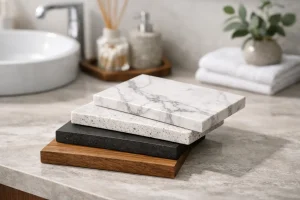
A countertop sample can make porcelain versus quartzite counters look like a simple style decision. Once you picture the surface around a sink, cooktop, island seating, and daily family routines, the choice becomes more practical. Both materials deliver a premium result, but they behave differently during fabrication, installation, and everyday use.
Porcelain offers a highly controlled, low-maintenance surface with impressive resistance to staining and heat. Quartzite is a natural stone with depth, movement, and individuality that cannot be exactly repeated. The right choice depends on how you use the room, the look you want to achieve, and how much ongoing care you are comfortable providing.
Porcelain versus quartzite counters: the core difference
Porcelain is a man-made surface created from refined clays and minerals fired at very high temperatures. Large-format porcelain slabs are dense, thin, and available in an extensive range of colors and patterns, including convincing marble, concrete, metal, and stone looks. Sintered stone products are closely related in performance and are often considered alongside porcelain during material selection.
Quartzite is a natural stone formed when sandstone changes under intense heat and pressure. Its mineral structure gives it strength, while natural veining and crystalline variation give each slab its character. Genuine quartzite should not be confused with quartz, which is an engineered surface made with ground stone and resin.
That distinction matters. Porcelain is designed for visual consistency and easy care. Quartzite is selected for natural beauty, with all the variation and maintenance considerations that come with real stone.
Appearance: controlled design or natural movement?
For homeowners seeking a clean, tailored kitchen, porcelain can be remarkably versatile. A large porcelain slab can create the look of white marble without the same concern over etching from lemon juice, vinegar, or wine. It can also suit contemporary projects that call for a soft concrete finish, a dramatic dark surface, or a uniform color across counters and backsplashes.
Because porcelain patterns are manufactured, it is possible to plan the layout with more predictability. This is particularly helpful when a project includes a full-height backsplash, waterfall island ends, or coordinated wall cladding. The fabricator can review the slab design and determine where veins, joins, and cutouts will fall before production.
Quartzite has a different appeal. Its veining is not printed or repeated. Some slabs have subtle linear movement, while others feature bold waves, translucent areas, or dramatic color shifts. A quartzite island can become the visual center of a kitchen precisely because it is one of a kind.
The trade-off is that a small sample cannot show the full story. Always view the actual quartzite slab whenever possible. Natural fissures, mineral deposits, and variation are part of the material, not flaws to be edited out. With the right slab selection and layout planning, those characteristics become part of a finished design with real depth.
Durability in a working kitchen
Both surfaces are strong choices for busy spaces, but they do not respond to every challenge in the same way.
Porcelain is highly resistant to scratches, stains, and heat. Its nonporous structure means everyday spills generally stay on the surface rather than soaking in. That makes it an appealing option for family kitchens, rental properties, entertaining spaces, and outdoor applications where low maintenance is a priority. It is also resistant to UV exposure, so its color is less likely to change in direct sunlight.
Its main consideration is not routine wear but impact. Porcelain slabs are thinner than many natural-stone slabs, and although they are very hard, the edges can chip if struck with a heavy pan or other hard object. A well-designed edge detail, careful handling, and professional installation all matter. Porcelain fabrication requires specialized equipment and experienced installers because the material can be difficult to cut and transport without proper support.
Quartzite is among the harder natural stones used for countertops. It performs well against scratching and heat, and it is generally more forgiving of impact along a substantial edge than a thin porcelain profile. Still, its performance varies by slab. Not every stone sold under the quartzite name has the same density or resistance to acids, which is why material verification and slab assessment are valuable before committing to a selection.
Quartzite can absorb liquids if it is not properly sealed. A quality sealer helps protect the surface, but it does not make the stone maintenance-free. Wipe up wine, cooking oil, coffee, and acidic foods promptly. Using cutting boards, trivets, and sensible daily care will help preserve its finish for years.
Heat and hot cookware
Both porcelain and quartzite tolerate heat well, which is a meaningful advantage near cooktops and baking areas. Even so, countertop care should not depend on the material’s maximum heat rating. A trivet is still the smart choice for hot cookware because sudden temperature changes, concentrated heat, and the weight of a heavy pot can affect seams, edges, or adjacent cabinetry.
Stains, acids, and cleaning
Porcelain is easier for households that want minimal maintenance. A soft cloth, warm water, and a mild cleaner are usually enough for everyday cleanup. Avoid abrasive pads and follow the product-specific care instructions for stubborn marks.
Quartzite needs a stone-safe cleaner and periodic resealing based on use and the particular slab. Acidic products should not be left on the surface. This level of care is manageable for many homeowners, but it should be an intentional choice rather than a surprise after installation.
Fabrication and installation affect the final result
A premium slab is only part of a successful countertop project. The finished appearance depends on accurate measurements, thoughtful layout, precise cutouts, edge finishing, seam placement, and careful installation.
Porcelain requires particular planning around support and edges. Its thinner profile can create a refined, modern look, but cabinet conditions must be assessed and reinforced where needed. Large islands, overhangs, undermount sinks, and mitered edges need fabrication decisions that suit the slab’s thickness and the way the space will be used.
Quartzite fabrication also calls for expertise. Natural slabs must be inspected for veining, fissures, and areas that may need reinforcement. A fabricator can plan cuts to showcase movement across an island or align the visual flow between the counter and backsplash. Seam locations should balance structural needs with the overall design.
At VE Stone, digital templating and CAD-guided fabrication help turn these decisions into a clear production plan before installation. That process is especially valuable for projects with detailed backsplashes, custom edge profiles, integrated drainboards, or large-format surfaces where precision is visible.
Cost: compare the whole project, not only the slab
There is no single price winner between porcelain and quartzite. Material availability, slab size, thickness, edge details, cutouts, backsplash coverage, site access, and installation complexity can all change the final project cost.
Porcelain may carry specialized fabrication costs because it requires specific tools, careful handling, and skilled labor. Quartzite prices vary widely based on rarity, origin, appearance, thickness, and slab quality. A dramatic natural quartzite can sit at the high end of a countertop budget, particularly when the design requires multiple slabs for matched movement.
The most useful comparison is an itemized quote based on your actual layout. Include the counter area, island, backsplash, sink cutout, cooktop cutout, edge profile, and any waterfall panels. That gives you a more accurate picture than comparing square-foot material estimates alone.
Which material fits your project?
Choose porcelain if you want a highly stain-resistant, low-maintenance surface with consistent design options. It is an excellent fit for a crisp modern kitchen, a busy family home, a full-height backsplash, or an outdoor surface exposed to sunlight and changing weather.
Choose quartzite if the priority is authentic natural stone and a slab with distinct movement. It suits homeowners who enjoy organic variation and are willing to follow a simple sealing and cleaning routine. In a kitchen where the island is meant to feel like a statement piece, quartzite can offer a level of visual character that manufactured surfaces intentionally cannot duplicate.
There is also room for a mixed-material approach. A homeowner may choose quartzite for a dramatic island and porcelain for a hardworking perimeter, backsplash, laundry room, or outdoor kitchen. The best plan is the one that supports how each area will actually be used.
Bring cabinet samples, flooring, paint colors, and inspiration images to your material consultation. Seeing full slabs under real lighting, discussing edge details, and reviewing your layout with an experienced fabricator will make the decision feel less like a gamble and more like a well-planned part of your renovation.